

Jessica* was sold on uterine fibroid embolization (UFE) from the moment her doctor mentioned it. After all, the last thing she wanted was a painful, drawn-out surgery with a lengthy recovery. UFE offered a way around that: no hospital stay, relief from the long, heavy periods and back pain she had dealt with for years, and a much faster return to the things she loved. But like many women, once Jessica decided on UFE, her next question wasn’t “How does the procedure work?” It was much more practical: “When can I return to work after UFE?”
Quick Answer: Most women need to plan for one to two weeks off work after UFE. If you have a desk or remote job, you may feel ready to return after about seven days if recovery is going well. If you spend the day standing, walking, driving, or doing physical labor, plan for closer to two weeks.
It is an important question to ask when you are planning any fibroid treatment, and UFE likely offers the fastest path back to work and everyday life. But most of what you will find online offers little more than a general 7- to 10-day timeline. That may not specific enough—especially when you need to tell HR how much PTO to request, and your job duties will affect how quickly you can safely return.
That is what this guide is designed to answer. Whether you spend your workday behind a desk, on your feet, or lifting and moving heavy objects, here is what to expect as you plan your return to work after UFE.
What Happens During the First Week of UFE Recovery?
Every woman’s fibroid journey is different, but since the Fibroid Institute offers a unique protocol for UFE and pain management, many patients tell us their discomfort is very manageable when they follow it. Much of this is because UFE is not surgery. Rather than physically removing fibroids, as in a hysterectomy or myomectomy, UFE blocks the blood flow feeding them, causing them to shrink and die. For the patient, that means going home the same day with only a small bandage over a tiny nick on your wrist.
You may feel pressure in your pelvis during the first few hours after UFE or feel as if you need to have a bowel movement. Over the next several days, cramping, fatigue, nausea, low-grade fever, and some vaginal spotting or discharge are also common. These are normal side effects of the treatment, and you will go home with prescriptions to help manage any discomfort. Even so, they are minor compared with the pain, incision care, and physical limitations that can follow major fibroid surgery, which can take weeks to recover from. A Cochrane review of randomized trials found that, compared with surgery, UFE led to a shorter hospital stay and a faster return to usual activities. Learn more about what to expect after UFE.
One of the best-known studies comparing the two, a randomized trial published in The New England Journal of Medicine, followed 157 women: 106 who had UFE and 51 who had surgery (43 hysterectomies and 8 myomectomies). One year later, quality-of-life scores were similar in both groups. But the UFE group spent less time in the hospital (a median of 1 day vs. 5 days) and returned to work significantly sooner.
“Most women need 1 to 2 weeks to recover after UAE before returning to work.” (UAE, uterine artery embolization, is another name for UFE.)

How Does Your Job Affect Your Return to Work After UFE?
After UFE, you will need pain medication and plenty of rest, and you can expect to feel better with each passing day. Most women recover completely in 7 to 10 days, though some cramping may linger for a week or two. Even if you feel great, we recommend taking at least a week off work to rest and recover. Most women get back to work and their normal activities quickly, but the biggest factor in deciding when you can return is not necessarily how you feel—it’s what your job requires you to do.
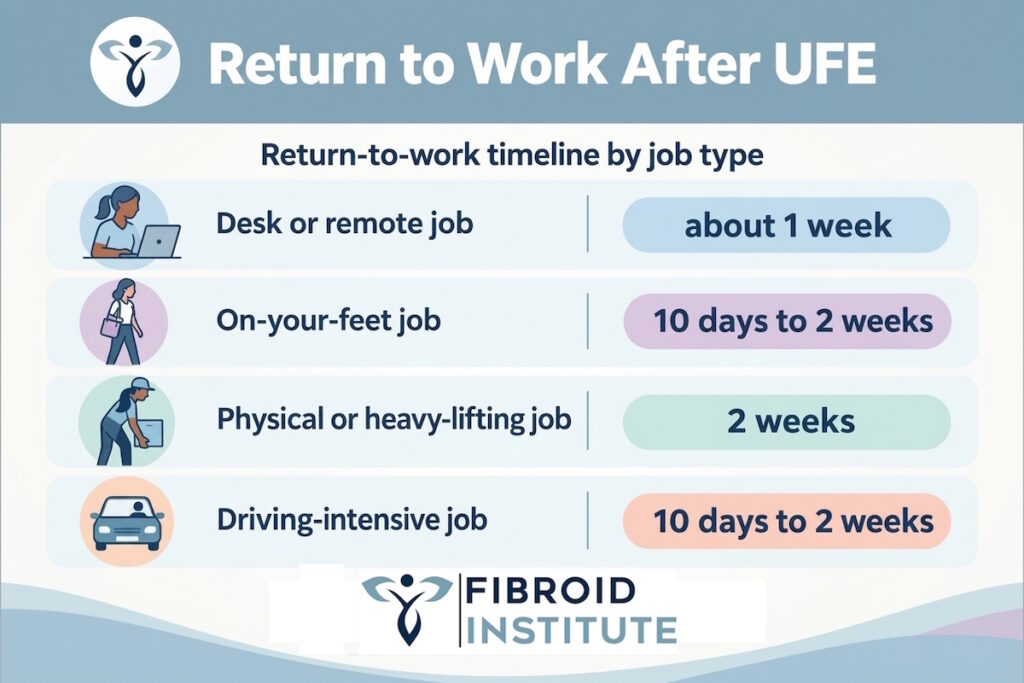
Someone who spends eight hours at a desk has very different physical demands than someone who stands all day or regularly lifts 25-pound boxes. Here is a simple breakdown of how to approach your return to work after UFE.
- Desk jobs — If you work as a receptionist, writer, administrative assistant, accountant, or in another office-based or computer-focused role, you can likely return to work around the seven-day mark if your symptoms are manageable. Desk jobs are easier on your body while you recover because you can sit, change positions, and take short breaks as needed.
- Remote jobs — Working from home full-time, or even part of the week, gives you added flexibility during the first week of recovery and may let you ease back into work sooner. For instance, if you feel fine but still want to follow your doctor’s advice to stay home for seven days, you can log in from your couch or kitchen table without getting dressed up and driving to the office. Remote work also lets you set your own pace and adjust your schedule as needed.
- Jobs that keep you on your feet — Retail, restaurant, healthcare, and warehouse jobs add physical exertion, fatigue, and discomfort to the mix as you return to work after UFE, so you may need 10 days to two weeks before you are ready to transition back. Other jobs that require a lot of standing include hair stylists, childcare workers, hospitality employees, nurses and other medical staff, and teachers.
- Physical labor — If your work requires heavy lifting, pushing, pulling, bending, climbing, or other physically demanding tasks, we recommend taking two weeks off before returning to work after UFE. We also recommend not lifting anything heavier than 20 pounds during those first two weeks. Doing too much too soon could lead to overexertion, added fatigue, and a slower recovery.
- Jobs that require driving — Driving may not feel strenuous, but you need to sit comfortably for your entire commute or route, get in and out of your vehicle easily, and react quickly when needed. You should not drive for at least 24 hours after UFE or while taking prescription pain medication, which can slow your reaction time and affect your judgment. If your job requires a lot of driving, we recommend taking 10 to 14 days off to fully recover.
How Can You Plan Your Time Off Work After UFE?
- Talk with your provider before and after the procedure — Your UFE specialist should give you a clear recommendation for time off before your procedure. That recommendation may change depending on how your procedure and recovery go, so be open and specific about the type of work you do.
- Tell your employer well in advance — Advance notice is always helpful when you need time off. These conversations can also cover your return, such as temporarily modified duties if your job is physically demanding, requires travel, or keeps you on your feet.
- Consider scheduling UFE around your days off — If possible, scheduling UFE before a weekend or planned days off can give you extra recovery time without that nagging feeling of “I should be back at work.”
- Plan for the possibility that you need more time — You may feel better by day seven. You may also have more cramping and fatigue than expected, making a full workday feel like too much. Have a backup plan so you can extend your time off if your body needs more recovery time.
Frequently Asked Questions (FAQs) About Returning to Work After UFE
Contact Fibroid Institute Today for Revolutionary Fibroid Treatment
One of the best benefits of UFE is a faster recovery and the ability to enjoy your life pain-free sooner. That said, everyone’s situation is unique, especially when it comes to returning to work. Consider your circumstances and decide whether seven days is enough time to return safely or whether you need more. And if you need more time, that is OK, too.

At the Fibroid Institute, we simplify your UFE journey by managing everything from recovery and pain management to return-to-work expectations, insurance, PCP communication, and everything in between—while giving all patients direct access to their fibroid doctor before and after their procedure. Our physicians are board-certified interventional radiologists and experts passionate about helping women become #FibroidFree. The bottom line is that you do not have to worry about the ongoing challenges of missing work and life events with UFE as your fibroid treatment.
At the Fibroid Institute, we do not believe you need to decide between suffering in silence and having invasive surgery. With multiple locations, our fibroid clinics help thousands of women avoid fibroid surgery and find relief from their fibroid symptoms. Meet some of these women here:
Request a free 10-15-minute phone screening to determine if you are eligible. If you qualify for UFE after the screening, you can schedule your on-site or telehealth consultation. Most major medical insurance providers cover the cost of UFE. Get started now by calling our Dallas, Texas clinics at 214-838-6440, Houston, Texas clinics at 713-903-3733, South Carolina clinics at 843-628-4290 or complete the form below.
"*" indicates required fields
Before starting any new treatment or if you have questions about a medical condition, always seek the advice of your doctor or other qualified health provider. This information is not a substitute for professional medical advice.
The Fibroid Institute serves the Charleston, South Carolina, Dallas/Fort Worth, Texas and Greater Houston, Texas metro areas including Addison, Allen, Arlington, Bedford, Bellaire, Carrollton, Central Houston, Cedar Hill, Charleston, Clear Lake, Cockrell Hill, Conroe, Craig Ranch, Cypress, Dallas, North Dallas, DeSoto, Duncanville, Euless, Fort Worth, Frisco, Garland, Grand Prairie, Highland Park, Houston, Hurst, Hutchins, Irving, Katy, Kingwood, Lancaster, League City, McKinney, Mesquite, Mt. Pleasant, Murrells Inlet, Orangeburg, Park Cities, Plano, Richardson, Sherman, Spring, Stafford, Sugar Land, Summerville, Texas City, The Woodlands, Universal City, University Park, Walterboro, Webster and more.
*Patient names and/or photos may be changed to protect patient confidentiality.
