
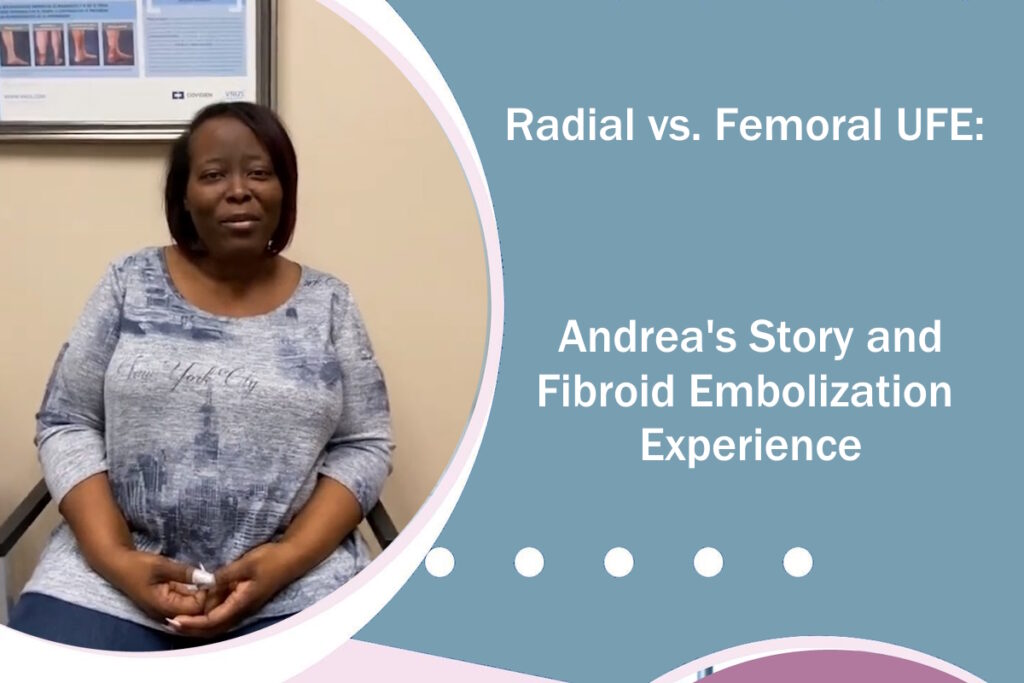
For Andrea*, there was no debate over which fibroid treatment she would choose. Granted, she knew she had plenty of options, but non-surgical uterine fibroid embolization (UFE) was always the clear-cut answer in her mind. Andrea hopes more women feel the same way. She also stresses the importance of understanding the different approaches to UFE after realizing that fibroid doctors can use two methods to access fibroids: through the femoral artery in the groin or the radial artery in the wrist. Both UFE approaches are ultimately the same—in terms of no hospital stay, no incisions, fast and efficient—and have similar success rates. However, Andrea had a better experience with the wrist puncture and suggests that other women consider it as well.
Andrea’s story is a powerful reminder that it is important to have an open and honest discussion with your doctor, so you fully understand all aspects of whichever fibroid procedure you choose. Even if you are sold on fibroid embolization with UFE, understanding how it is performed and what to expect before, during, and after treatment is essential to feeling confident in your decision. Fast forward to today, Andrea is proof that the right treatment can restore quality of life—no more heavy bleeding, period blood clots, bloating, or fatigue—simply the freedom to enjoy life again.
Femoral vs. Radial UFE: What’s the Difference?
Many women interested in UFE as their fibroid treatment of choice assume that the procedure is performed the same way for every patient by every fibroid specialist. It is not a wild assumption, especially when you consider there is no hospital stay, a shorter recovery, and that it is over 90% effective in treating all fibroids—regardless of size, type, and location. Statistics like that make you think doctors have a detailed yet cookie-cutter approach. But that is not always true. The reality is that while the objective is the same—shrink fibroids rather than remove them—how your fibroid doctor accesses those fibroids can vary from specialist to specialist.
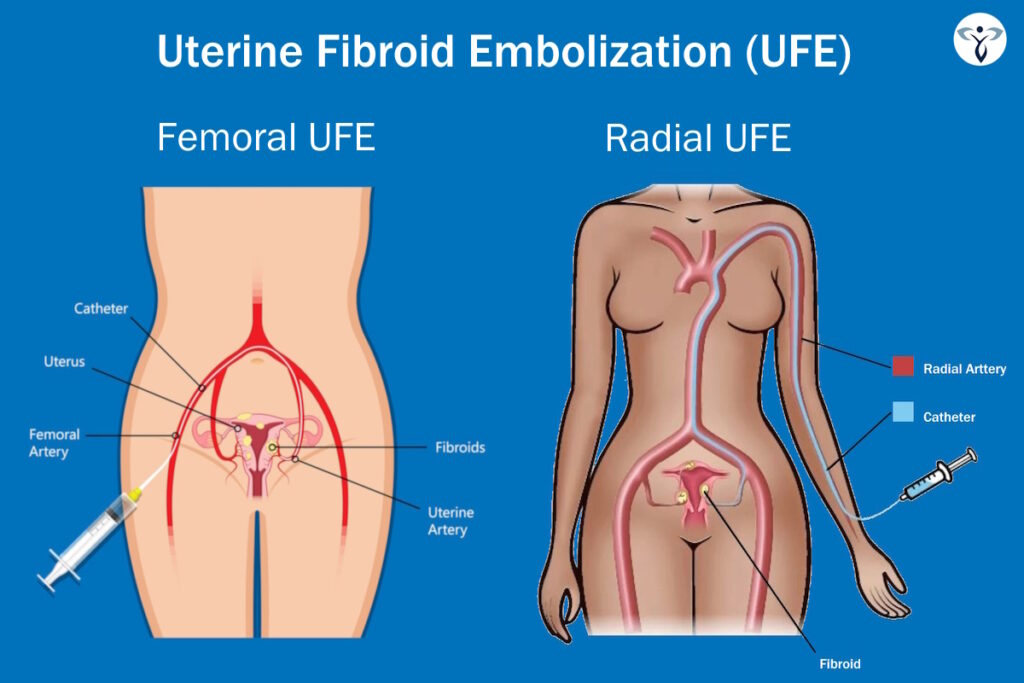
Currently, there are two procedural approaches to uterine fibroid embolization.
The femoral approach
This approach dates back quite a way and is widely considered the “traditional” approach. Essentially, your fibroid doctor will make a tiny puncture in the groin area, locate the femoral artery, and then insert a small catheter to help guide everything. Your doctor will choose the size of the embolic material inside the catheter to ensure that only the blood supply to the fibroids is blocked, not to the surrounding organs. We have a femoral artery in both legs, so finding that artery isn’t difficult.
The radial approach
In recent years, top clinics like the Fibroid Institute have relied more on the radial artery. Granted, it is a much longer path from your wrist to your uterus, but it achieves the same outcome and often provides patients with a more comfortable recovery experience and fewer mobility restrictions. The skills and experience of the provider can play a part in the success of this method.
Femoral Approach: “There were a lot of restrictions”
Andrea’s fibroid journey is unique in that she has undergone two UFE procedures. The first was done using the femoral artery approach. Andrea did not mince words when she said it did not play out the way she had hoped.
“I did not like the groin approach at all,” Andrea said. “I had to lie flat for a couple of hours [after it was over], and it was uncomfortable and depressing. There were a lot of restrictions.”
The femoral approach remains a popular option today, depending on the specific characteristics of each fibroid case and the doctor’s preferences. That said, an increasing number of fibroid specialists have steered away from it because of several downsides. Andrea was asked to lie down for several hours post-procedure because of a high risk of bleeding. This is because the femoral artery is typically between seven and eight millimeters across and often requires lengthy compression if the closure device doesn’t adequately seal the wound. If someone like Andrea were to get up and move around too quickly, she could be dealing with a slew of potential side effects.
Andrea said she chose to do UFE again with the Fibroid Institute, which specializes in innovative treatment using the radial approach. Medicine and x-ray-guided imagery have advanced tremendously over the years. Catheters have also become smaller, enabling quick, painless access. From there, the result is relief from a variety of life-interrupting symptoms:
- Painful periods, including heavy or inconsistent cycles
- Debilitating cramps, pelvic pain, and pressure
- Back or leg pain
- Bloating or swelling in the lower abdomen
- Weight gain
- Pain during sexual intercourse
- Urinary frequency
- Constipation, diarrhea, and rectal discomfort
“It was amazing. No pain; I just had to keep the Band-Aid on for another couple of days,” Andrea said at her follow-up. “I could move around. It was fantastic. I would definitely recommend this approach.”
How Much Does the Radial UFE Procedure Make a Difference?
Andrea pretty much said it all. We believe our approach to UFE stands out because passing the catheter through the wrist (nothing more than a small needle prick) has consistently reduced patient pain during and after the procedure compared with advancing the catheter through the groin. Once the procedure is complete—usually in roughly an hour—you will notice only a small bandage over a nick on your wrist.
“Fixing fibroids with a small wrist nick” is commonly what patients like to say.
From there, we follow a proactive customized pain management algorithm. As a result, their patients report little to no pain when they follow the recommended medication chart.
Key Takeaway: Radial UFE and femoral UFE achieve the same treatment goal—shrinking fibroids by blocking their blood supply. The main difference is how the fibroid doctor accesses uterine arteries. For many women, understanding these options can help them feel more confident and prepared before treatment.
Questions to Ask When Choosing UFE
Before scheduling treatment, consider asking your fibroid specialist:
- Do you perform UFE through the radial artery, femoral artery, or both?
- Which approach do you recommend for my case and why?
- What can I expect during recovery?
- How many UFE procedures have you performed?
- What results have your patients experienced?
- Will my insurance cover treatment?
Revolutionary Fibroid Treatment Is Here. Let’s Talk Today!
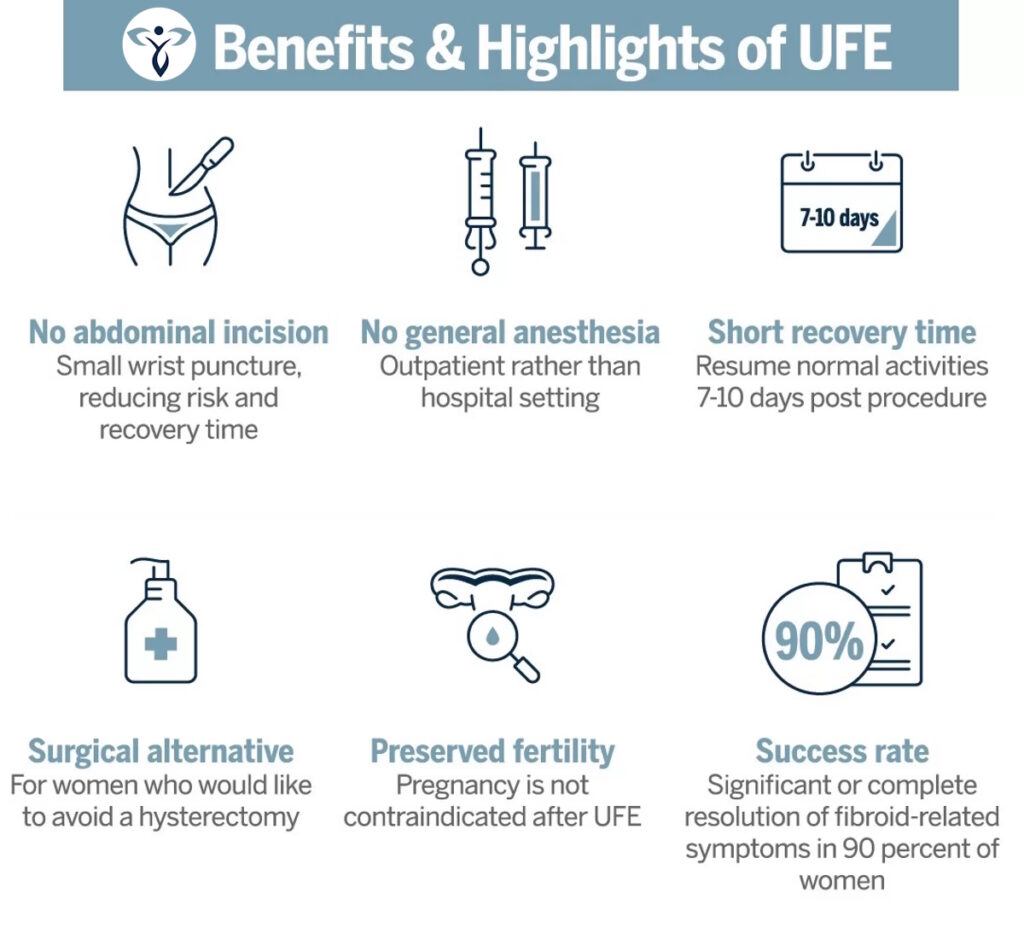
At the Fibroid Institute, we are dedicated to treating fibroids using uterine fibroid embolization (UFE), the gold standard in non-surgical fibroid treatment. Furthermore, we have perfected our approach to this life-changing procedure and believe the radial artery achieves the best results in the least invasive way. When using the radial artery, we simply make a tiny nick on the patient’s wrist, guide the catheter to the fibroid, and cut off its blood supply.
“It was amazing. No pain. I could move around. It was fantastic. I would definitely recommend this approach.”
If uterine fibroid embolization (UFE) is your preferred option, the only decision left is to select the right interventional radiologist for your care. Beyond the procedure itself, women want an experienced fibroid doctor who provides access, communication, comfort, innovation, trust, and a supportive experience from start to finish. The Fibroid Institute is here to offer you just that.
In addition, we simplify your UFE journey by managing everything from insurance to PCP communication, while providing all patients with direct access to their fibroid doctor’s mobile phone before and after their procedure. Our physicians are board-certified interventional radiologists and experts passionate about helping women become #FibroidFree. The bottom line is that you do not have to worry about missing work or life events with UFE as your fibroid treatment.
With multiple locations, our fibroid clinics help thousands of women avoid fibroid surgery and find relief from their fibroid symptoms. Meet some of these women here:
Request a free 10-15-minute phone screening to determine if you are eligible. If you qualify for UFE after the screening, you can schedule your on-site or telehealth consultation. Most major medical insurance providers cover the cost of UFE.
Get started now by calling our Dallas, Texas clinics at 214-838-6440, Houston, Texas clinics at 713-903-3733, South Carolina clinics at 843-628-4290 or complete the form below.
"*" indicates required fields
Frequently Asked Questions (FAQs) About Femoral and Radial UFE
This information is not a substitute for professional medical advice. Before starting any new treatment or if you have questions about a medical condition, always seek the advice of your doctor or other qualified health provider.
The Fibroid Institute serves the Charleston, South Carolina, Dallas/Fort Worth, Texas and Greater Houston, Texas metro areas including Addison, Allen, Arlington, Bedford, Bellaire, Carrollton, Cedar Hill, Charleston, Clear Lake, Cockrell Hill, Conroe, Craig Ranch, Cypress, Dallas, DeSoto, Duncanville, Euless, Fort Worth, Frisco, Garland, Grand Prairie, Highland Park, Houston, Hurst, Hutchins, Irving, Katy, Kingwood, Lancaster, League City, McKinney, Mesquite, Mt. Pleasant, Murrells Inlet, Orangeburg, Park Cities, Plano, Richardson, Sherman, Spring, Stafford, Sugar Land, Summerville, Texas City, The Woodlands, Universal City, University Park, Walterboro, Webster and more.
*Patient names and/or photos may be changed to protect patient confidentiality.
