

Brittany* was used to experiencing heavier-than-usual menstrual cycles. They had been that way for most of her adult life and did not require anything from her besides being extra prepared for that time of the month. That is, until she gave birth to her daughter. Her cycles were suddenly getting heavier … and heavier—to the point where she was humiliated by the thought of bleeding through her clothes if she sat in one place for too long. Couple that with constant bloating, depleted energy, headaches, and struggling to even get out of bed in the morning, and it was not long before she was at her wits’ end. The culprit: uterine fibroids. Her doctor suggested a hysterectomy, but that was the last thing Brittany wanted—even though she knew her symptoms would only get worse if she did not do anything. Thankfully, she was referred to Fibroid Institute, where a nonsurgical option called Uterine Fibroid Embolization (UFE) was officially on the table. With the promise of fibroid removal without surgery and a shorter recovery time, Brittany jumped at the chance to finally reclaim the life she deserved.
Brittany’s story is a powerful reminder that uterine fibroids can disrupt life in numerous ways and at any age. At only age 37, she was being asked to consider life-altering surgery when she needed to focus on raising her kids, advancing her career, and simply feeling like herself again. When we interviewed Brittany, she could not stop talking about the relief she felt knowing there was a solution without surgery. Today, she is proof that the right treatment can restore quality of life—no more heavy bleeding, bloating, or exhaustion, just the freedom to live fully again.
“The fibroid and symptoms got to the point where it was hard for me to even get out of bed in the morning,” Brittany said. “It took everything out of me, and I’m thinking, ‘I’m only 37 years old, and I have two small kids. But I just felt bad every single day. My doctor said UFE is supposed to be a great option; it’s less invasive, and the recovery time is shorter. I said, ‘OK, let’s try it.’ And I’m so glad that I did.”
Brittany’s Fibroid Symptoms
Heavy menstrual bleeding
Bloating and weight gain
Lack of energy
Headaches daily
Hard to get up in the morning
Brittany’s Fibroid Journey: A Textbook Example of How Fibroid Symptoms Evolve
So, Fibroids are extremely common and typically impact women during their 30s and 40s and through menopause. So, Brittany was right there in the “sweet spot” for developing fibroids. After all, they tend to grow at faster rates and in greater numbers during a woman’s reproductive years because they are under hormonal control—and that is the stage of life when women experience their highest hormone levels.
Here is a breakdown of what is considered a small or large fibroid—and why size matters when it comes to symptoms.
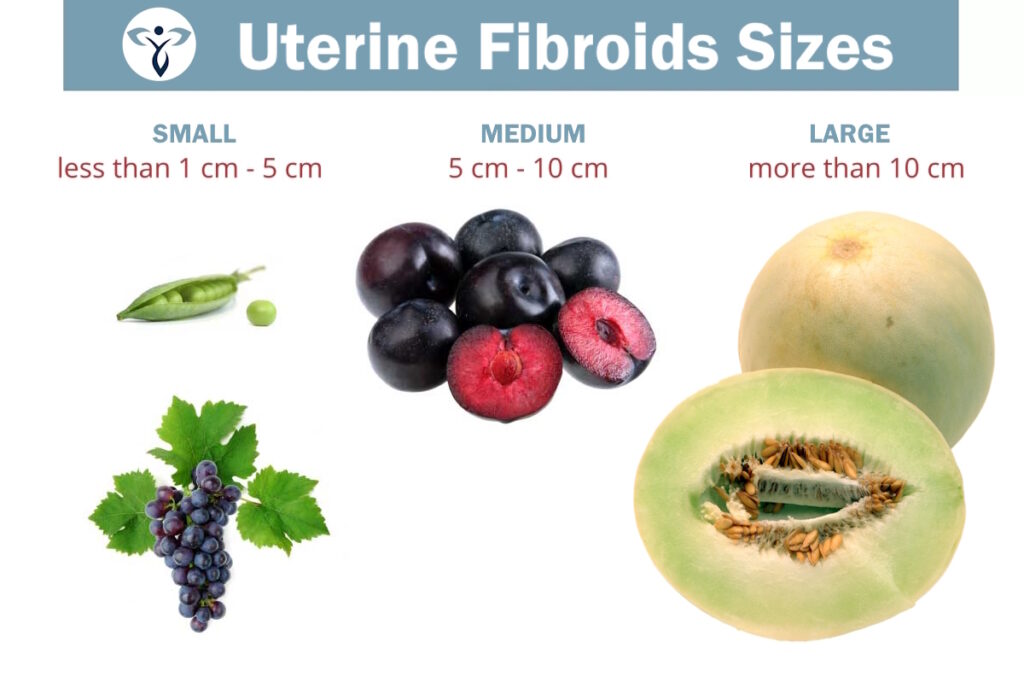
The larger fibroids get, the more disruptive they can become. As a result, fibroids and fibroid symptoms can and will evolve over time and quickly become a condition that can span decades of your life without the proper awareness and treatment options such as fibroid removal. This is why Brittany experienced increasingly heavier menstrual bleeding and other symptoms in her mid- to late-30s. That said, it is very possible that her fibroids developed much earlier—potentially even in her late 20s, when symptoms are rare, mild, or easy to dismiss.
According to one study, approximately 1.8% of women aged 20 to 29 were diagnosed with uterine fibroids. Remember, she said her heavy periods started much earlier in life, so early that she thought it was a normal part of being a woman. But that assumption could not be more off base. By the time Brittany reached her 30s and began having children, those once-quiet fibroids evolved into something far more disruptive. Her symptoms intensified, and that excessive bleeding eventually led to fatigue, low energy, and the constant feeling that something was not right.
“I wanted desperately to go outside and kick the ball with the kids and bounce around with them. But during that time of the month, it was harder,” she said. “I also had to wear dark clothes, just in case of an accident. It was the most embarrassing, humiliating thing as a woman. Even my husband did not know what to do to help.”
Brittany’s experience reflects how fibroids often progress: slowly at first, then more aggressively during a woman’s 30s, when hormonal shifts, pregnancy, and childbirth can accelerate both fibroid growth and symptom severity.
“The fibroid and symptoms got to the point where it was hard for me to even get out of bed in the morning. It took everything out of me, and I’m thinking, ‘I’m only 37 years old, and I have two small kids. But I just felt bad every single day.”
Fibroid Removal: It’s Important To Know All Your Options
When a woman is diagnosed with fibroids, one of the first solutions many doctors turn to is fibroid removal surgery such as a hysterectomy. Roughly 600,000 hysterectomies are performed in the U.S. each year, making it the second-most common gynecological surgery after a C-section. It is also highly effective since it removes all or part of a woman’s uterus and, in some cases, the fallopian tubes and ovaries—everywhere fibroids could possibly grow and cause discomfort.
But many women are hesitant to undergo such a life-altering procedure. Brittany was certainly no different.
“Call it woman’s intuition … I just was not ready for surgery,” Brittany said. “I was young, and I wanted my body to go through the natural processes. The idea of surgery did not put me at ease … at all.”
Brittany said she discussed several options with her doctor, which was a great start since the number of options available to women has increased over the years. Just a few include:
- Acessa — A small probe is placed into a fibroid and heated. By heating the fibroid, it is ultimately destroyed. Acessa works even if you have several uterine fibroids. But there are limitations. For example, if you have multiple large fibroids (melon or grapefruit size) or fibroids that are hard to get to, Acessa is not a good choice.
- Endometrial Ablation — Removes the uterine lining by placing a thin instrument into the uterus through the cervix and using heat, laser, electricity, microwaves, or freezing. The downside to endometrial ablation is that it is not safe to get pregnant after you’ve had it. In addition, it is most effective with only small fibroids.
- Hysterectomy — This popular form of fibroid removal is still widely used today. It is also highly effective, though many women hope to avoid it due to its invasive nature. A hysterectomy removes all or part of a woman’s uterus. In some cases, her fallopian tubes and ovaries are removed, too. It’s important to note that it takes longer to heal from a hysterectomy, and your body will never be the same again.
- Myomectomy — Myomectomy preserves the uterus while removing the fibroids. As a result, it is the procedure of choice for women who want to get pregnant. However, it eliminates the ability to have a vaginal birth in the future. Like hysterectomy, is a surgical precures that recovery downtime and weeks of recovery. The size and location of the fibroids determine how this surgery is performed.
- Sonata System — This incision-less fibroid treatment works well when the patient has one or several fibroids. Using an intrauterine ultrasound device, radiofrequency energy is delivered to the fibroid to shrink the fibroid. As the fibroid shrinks, the patient can see a reduction in painful symptoms.
- Uterine Fibroid Embolization (UFE) — UFE is a minimally-invasive procedure that, rather than removing fibroids surgically, stops blood flowing to the fibroids—causing them to shrink and die. UFE is low risk, has no incision, is faster than other options, and is a safe and highly successful alternative to surgery.
“My doctor said UFE is supposed to be a great option; it’s less invasive, and the recovery time is shorter. I said, ‘OK, let’s try it.’ And I’m so glad that I did.”
Fibroid Removal: “I Definitely Recommend UFE”
Brittany’s doctor ultimately discussed UFE as a viable option for her unique situation. Brittany was intrigued by UFE because it was minimally invasive rather than fibroid removal via surgery. With UFE an interventional radiologist makes a small puncture in your wrist and, with the help of a catheter, injects tiny particles of embolic material that block nonessential blood vessels leading to the fibroids. Without this ongoing blood supply, fibroids no longer have what they need to grow inside the uterus. As a result, they naturally shrink and die—thus eliminating painful symptoms. It is a low-risk procedure that results in nothing more than a tiny dot on your wrist and is faster than some alternatives.
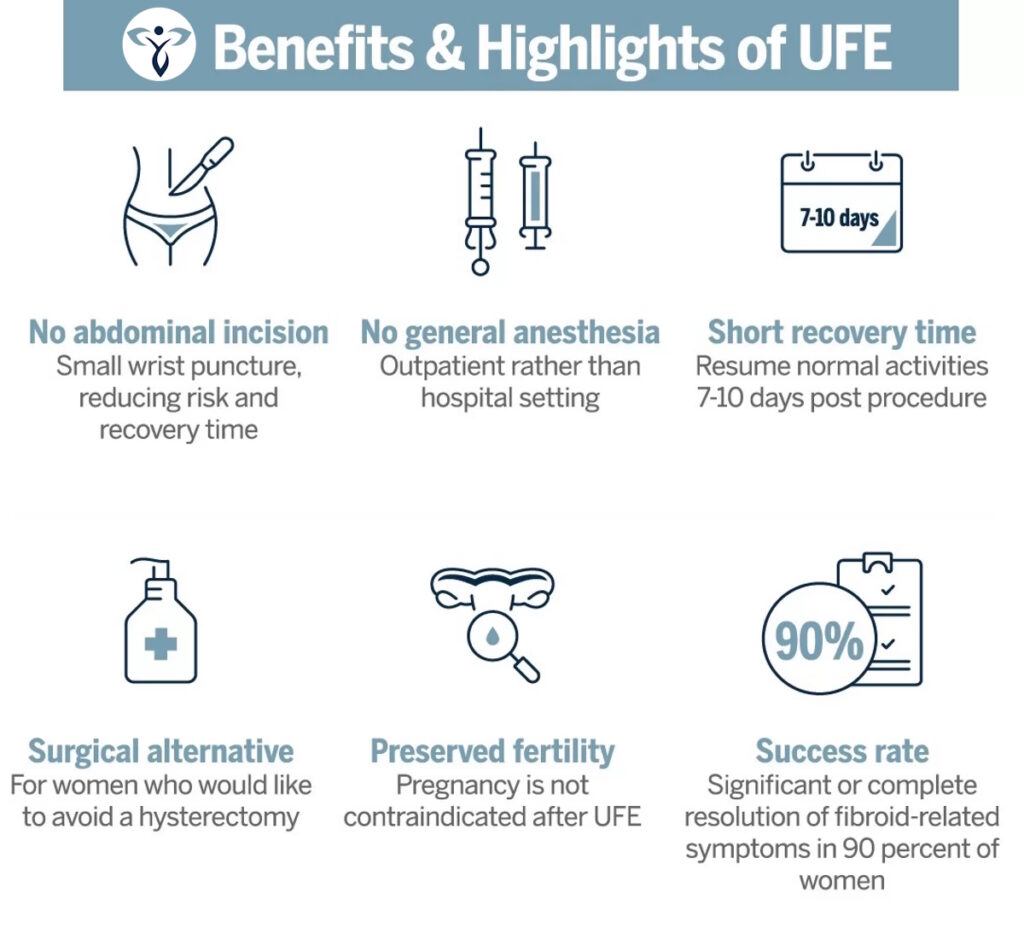
Just a few advantages of UFE at Fibroid Institute include:
- Innovative, advanced procedure
- No hospital stay
- Shorter recovery period (one week in some cases)
- No scarring
- All fibroids may be treated at the same time
- Dramatic reduction in fibroid symptoms
- The uterus is spared
- Concierge-level medical care
- Access to your fibroid doctor’s mobile number
Fast-forward to today, and Brittany feels so much better. She is not bloated all the time; her energy has increased, and there are no more concerns over potentially bleeding through her clothes during that time of the month.
“I was at my worst, and now I feel like a new person,” she added. “I would 100% recommend the UFE procedure to lots of women dealing with fibroids. Fibroid Institute’s staff is amazing and will make you feel so comfortable.”
Fibroid Removal Without Surgery Is Possible at Fibroid Institute
Brittany’s story is a powerful reminder that uterine fibroids can disrupt life in numerous ways and at any age. If you are experiencing these or any other fibroid symptoms, and you are worried about what options are available to help you reclaim your life, please call Fibroid Institute. We help women at all ages and stages in their journey who are experiencing disruptive fibroid issues get back to the lives they were meant to live. This is the gift a fibroid doctor can provide through uterine fibroid embolization (UFE).
At Fibroid Institute, we set the standard of care for advanced fibroid treatment and help women achieve a symptom-free life. We specialize in UFE because it delivers results in the least amount of time and with limited pain. On top of that, we simplify your UFE journey, managing everything from insurance to PCP communication and offering all patients physician-direct access before and after their procedure.
Very few practices across the country are dedicated 100% to fibroid treatment. That is where Fibroid Institute makes its mark. With multiple locations, our Dallas and Houston fibroid clinics help thousands of women avoid fibroid surgery and find relief from their fibroid symptoms. Our fibroid doctors are board-certified interventional radiologists and experts passionate about helping women become #FibroidFree.
Most major medical insurance providers cover the cost of UFE. Request a free 10-15 minute phone screening to determine if you are eligible. After the screening, if you qualify for UFE, you can schedule your onsite or telehealth consultation. Get started now by calling our Dallas, Texas clinics at 214-838-6440, Houston, Texas clinics at 713-903-3733, South Carolina clinics at 843-628-4290 or complete the form below.
"*" indicates required fields
This information is not a substitute for professional medical advice. Prior to starting any new treatment or if you have questions regarding a medical condition, always seek the advice of your doctor or other qualified health provider.
The Fibroid Institute serves the Charleston, South Carolina, Dallas/Fort Worth, Texas and Greater Houston, Texas metro areas including Addison, Allen, Arlington, Bedford, Bellaire, Carrollton, Cedar Hill, Charleston, Clear Lake, Cockrell Hill, Conroe, Craig Ranch, Cypress, Dallas, DeSoto, Duncanville, Euless, Fort Worth, Frisco, Garland, Grand Prairie, Highland Park, Houston, Hurst, Hutchins, Irving, Katy, Kingwood, Lancaster, League City, McKinney, Mesquite, Mt. Pleasant, Murrells Inlet, Orangeburg, Park Cities, Plano, Richardson, Sherman, Spring, Stafford, Sugar Land, Summerville, Texas City, The Woodlands, Universal City, University Park, Walterboro, Webster and more.
*Patient names and/or photos may be changed to protect patient confidentiality.
